
When Motherhood Feels Like Too Much: How Accelerated Resolution Therapy Can Help You Reset
Nighttime is the hardest for me. When the bedtime routine doesn’t go as planned and my brain and body have been managing to hold it together all day, but now there is little left. When we only had one child, we could switch off more. Turn off the noise for a little while or tap out of bedtime when we needed it. But when that second and third child (for me it is only two!) come with their own bedtime struggles, the noise and overwhelm feels especially intense. That feeling when your brain and body have hit their limit and the sounds of one more whine or call from the room feel like they might send you over the edge. And then there is the guilt for losing it afterwards. It’s a lot to hold. If you're a mom who has ever thought I don't want to be this reactive, you are not alone.
This post is about a therapy approach called Accelerated Resolution Therapy (ART). What it is, why it works, and how it can specifically help moms who are overwhelmed, overstimulated, and ready to show up differently for themselves and their families. I'm a therapist based in Arlington, Virginia, and I work with moms across Northern Virginia and the DC area who are navigating exactly this.
The Weight of Everyday Motherhood and Mom Rage
In my practice, I see many moms who are struggling with the day-to-day. It isn't necessarily postpartum depression, though moms experiencing anxiety or depression often also feel very on edge and irritable. It can also be the slow accumulation of being needed by everyone, all the time. The noise, the interruptions, the mental load. It all stacks on top of each other until your nervous system is so dysregulated that the tiniest thing sets you off.
On social media we often hear this called “mom rage” and it can look like:
Dreading the witching hour before dinner, knowing the chaos is coming and feeling powerless to meet it with any calm
Snapping at a child over something small and then spiraling into shame and guilt
Feeling like you are always one request away from completely losing it
Replaying arguments, accidents, or stressful moments in your mind long after they're over
This isn't because you're a bad mom. It's a nervous system that has been in overdrive and is reacting. I often say that when we're experiencing rage as a mom, it is an important piece of information. It means the brain's threat-detection system normally designed to protect you is on alert. And it tells us that we are missing some crucial pieces in being able to take care of ourselves and our own needs.
Traditional talk therapy can help you understand why you feel this way. But understanding something cognitively doesn't always change how your body responds in the moment. That's where Accelerated Resolution Therapy offers something different.
Why Accelerated Resolution Therapy Works When Other Approaches Don't
As a therapist, I've watched clients spend months and sometimes years developing insight into their patterns and still find themselves reacting in ways they don't want to. Often clients come to me with incredible insight into what might be leading them to feel the way they do, or things in their childhood that may be at the root of how they are feeling. This is such an important piece of the puzzle. But understanding the root of a behavior and actually changing it are two very different things. Accelerated Resolution Therapy bridges that gap.
ART is an evidence-based treatment that uses guided eye movements similar to those used in EMDR combined with specific imagery techniques to help the brain reprocess distressing memories and experiences. The eye movements are similar to how your eyes move during REM sleep, the time your body is best at processing. The problem is, your dreams free associate. They don't necessarily target the things you most need to process from your day to reduce the sensations that might get stuck.
I also often use tappers in my practice. These are handheld devices that deliver bilateral stimulation through gentle vibrations while you hold one in each hand. Most clients find them very relaxing, and you are able to close your eyes during processing. Like eye movements, tappers engage both hemispheres of the brain, promoting communication and integration between them. ART was developed by Laney Rosenzweig and has a growing research base, originally built around trauma, PTSD, anxiety, and depression.
Here's what makes it particularly powerful for moms dealing with rage and overwhelm: ART works at the level of the nervous system, not just the thinking mind. When we experience something stressful, even something that seems small (like being screamed at by three kids simultaneously) the brain encodes that experience along with all the sensory and emotional data that came with it. Over time, repeated stressors create ingrained neural pathways that trigger automatic reactions: the sharp tone, the shutdown, the mom rage and overwhelm that seems to come out of nowhere.
ART uses bilateral stimulation to interrupt these patterns while you hold an image or scenario in mind. This allows the brain to reprocess the experience. You keep the factual memory, but strip away the emotional charge. Clients frequently describe it as feeling like the memory still exists, but it no longer grabs them the way it did before.
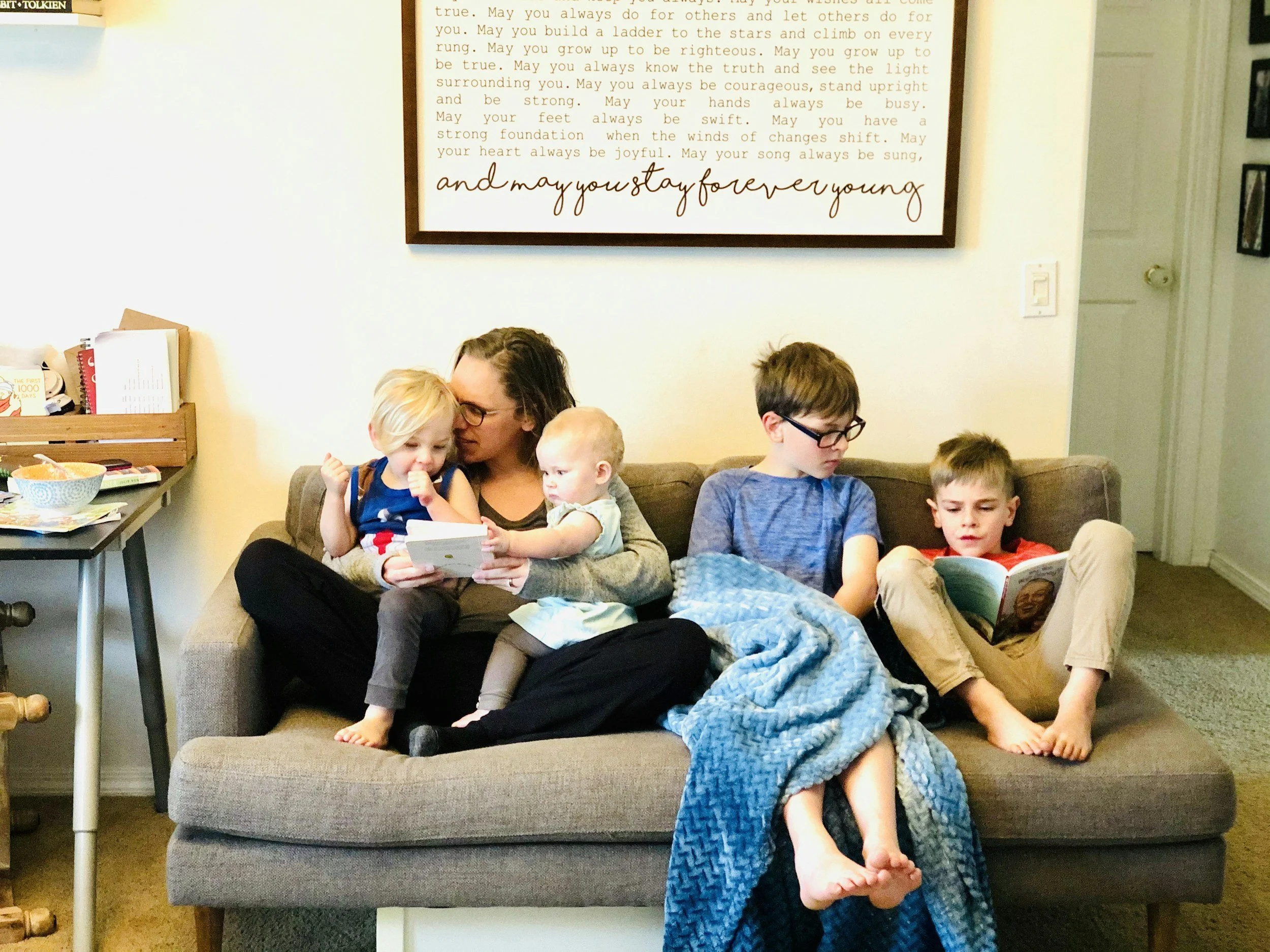
A mom managing the day-to-day.
How ART Helps Moms Rewrite Their Typical Day
So let’s talk about how this looks for a mom who isn't processing a single traumatic event, but rather the cumulative stress of everyday family life. This is where one of ART's Typical Day protocol can be so helpful.
Rather than targeting a specific traumatic memory, the Typical Day script walks you through your ordinary day from waking up to bedtime using eye movements to help your nervous system rehearse a calmer, more grounded version of yourself.
In session this might look like identifying the moments in your day that feel most charged. Maybe it's the morning rush when the kids are refusing to do the basic tasks you need to get out the door. Maybe it's the late afternoon when you're exhausted from work and the kids are tired from daycare and school. Maybe it's the moment a child ignores you for the fourth time and you feel your chest getting tight.
Using eye movements or the gently vibrating tappers, you first process the distress connected to those moments, letting the nervous system and brain process these difficult moments. Then you use imagery to replace that scene with how you want to respond. You literally picture yourself in those same moments: regulated, patient, present. And you hold that image while continuing the eye movements.
But it isn’t just wishful thinking or visualization. The eye movements help the brain encode the new imagery more deeply, essentially rehearsing a different neural response so it becomes more accessible in real life. Clients often describe walking out of session feeling like they can actually picture being the mom they want to be. Not as an abstract ideal, but as something that feels within reach.
One client came in describing her afternoons as a "pressure cooker." After a combination of talk therapy and ART sessions using the Typical Day protocol, she told me she felt like she could pause now before reacting. Afternoons aren’t perfect, but she is able to handle it.
That tiny pause between stimulus and response makes such a difference. If you're curious about whether ART might be a fit for you, you can also explore the published research on ART and stress for a deeper look at the evidence base.
Ready To Feel Like Yourself Again?
You don't have to keep bracing for the hard moments. Your nervous system can learn something new, and you can feel better.
At Connected Beginnings, I'm an Arlington, Virginia-based therapist working with moms across Virginia and Washington, DC who are exhausted by their own reactivity and ready for something that actually moves the needle. I offer both in-person and virtual sessions, so wherever you are in the DC area, support is accessible. If you're curious about whether Accelerated Resolution Therapy is a good fit for you, I'd love to connect.
