
Is This Postpartum Anxiety? What It Actually Feels Like (And What To Do About It)
It's 2am. Your baby is finally asleep. You should be too. You're exhausted in a way you didn't know was possible. But instead you find yourself checking every few minutes to make sure your baby is still breathing, thoughts racing, unable to quiet your mind. In the morning you spend the precious minutes you could be getting a coffee for yourself tracking poops, pees, and wake windows. You thought the hard part would be the exhaustion. You didn't expect to feel so out of control.
If this sounds familiar, you might be experiencing postpartum anxiety and you're far from alone. This post is for new moms in that uncertain place where something feels off but you're not sure if what you're feeling is normal new parent worry or something worth paying attention to. We'll look at what postpartum anxiety actually looks like, why it so often goes unrecognized, and what genuinely helps.
When New Mom Worry Becomes Something More: Understanding Postpartum Anxiety
When most people think about postpartum mental health, they think about postpartum depression. But postpartum anxiety is actually more common and it often goes unrecognized by doctors, partners, and the moms experiencing it themselves.
Postpartum anxiety is excessive worry that sticks around and makes it harder to fully enjoy the early months of motherhood. It often develops in the first weeks or months after birth but can emerge anytime in the first year. It can look like hypervigilance, constant alertness, and a low-level hum of fear that something bad is about to happen. Sometimes it can look like irritability when things start to feel out of control.
So what does postpartum anxiety actually look like beyond the obvious? It might be a mom who can't sleep even when the baby sleeps, her body exhausted while her mind keeps spinning. It might be intrusive thoughts about accidents or illness that feel terrifying and shameful to admit. It might be a persistent sense of unease even in calm moments, worries around every feeding, or snapping at your partner and then feeling awful about it. Sometimes it looks like a mom who seems completely on top of everything. Because she is, maybe your brain tells you you always need to stay in control. That’s really hard after a baby when things become so unpredictable.
Some worry after having a baby is completely normal. Everything is new, and feeling unsure is part of that. The difference with postpartum anxiety is the intensity, frequency, and how much it's starting to take over. And you don't have to meet some clinical threshold to deserve support. This is a huge transition, and a safe space to process it matters regardless of how intense things feel. Sometimes I have moms reach out who aren’t sure they have postpartum anxiety, but may just benefit from support during a huge transition that comes with typical worry. That’s okay too!
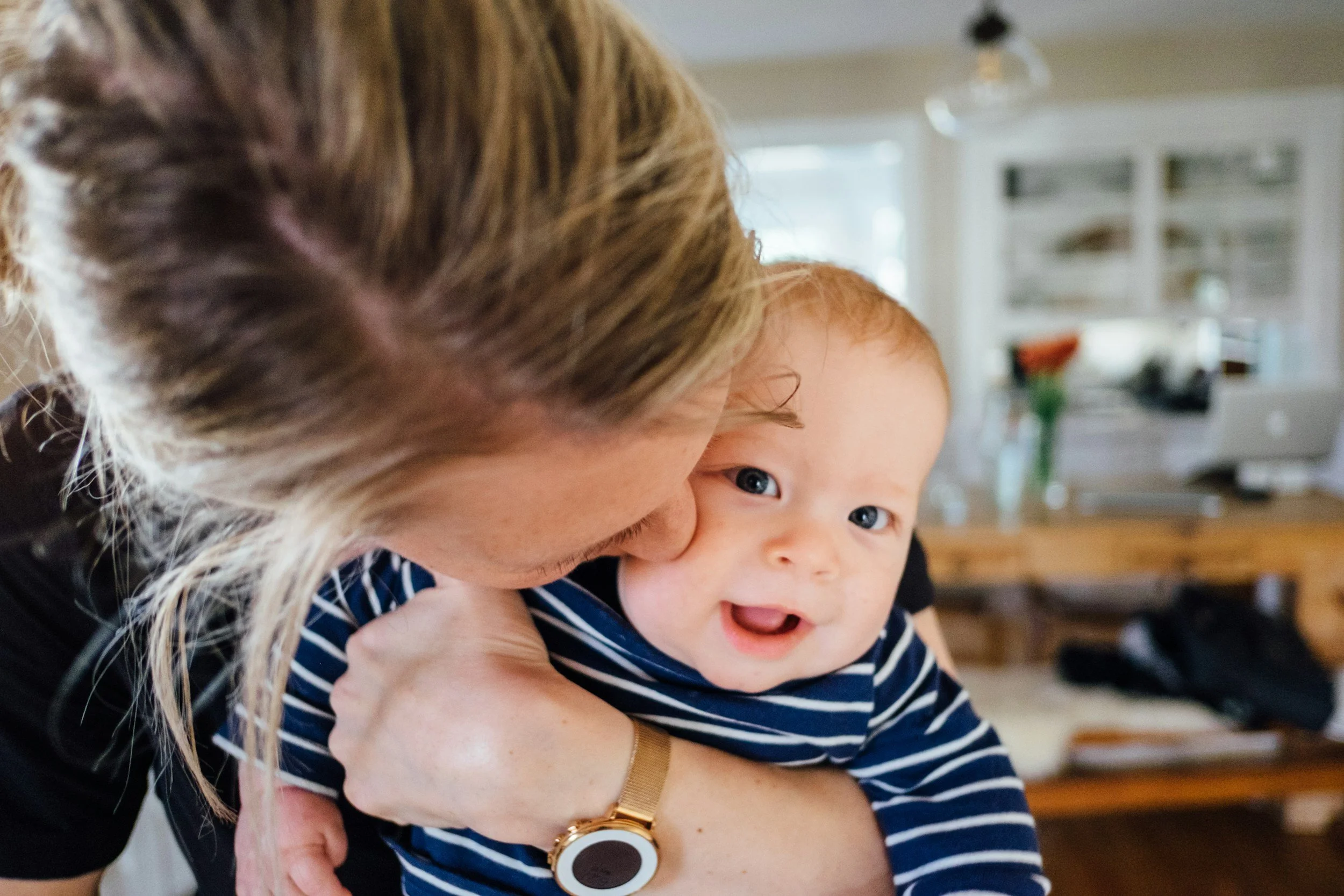
Mom kissing baby.
It's Not Just Worry: A Therapist's Perspective on Postpartum Anxiety
Here's something I want new moms to hear clearly: postpartum anxiety is not a character flaw, and it's not a sign you're failing at motherhood. It's a clinical condition with a clear name and real, effective treatment. But it's one that gets missed a lot because it doesn't always look the way people expect.
One of the most common questions I hear is: "But isn't some worry just… normal?" Yes, and that's exactly what makes postpartum anxiety so tricky to identify. A few things worth sitting with:
Is the worry proportionate to the actual risk? Checking on your baby once before bed is normal. Checking ten times and still being unable to sleep is worth paying attention to.
Is it interfering with daily life? If anxiety is affecting your sleep, your relationships, your ability to function, or your ability to enjoy time with your baby, that matters.
Does it feel controllable? Normal worry tends to come and go. Postpartum anxiety can feel relentless, like a volume dial you can't turn down.
Has it lasted more than two weeks? Anxiety that persists rather than easing as you settle into a rhythm deserves attention.
Postpartum anxiety also thrives in isolation. It tells you that you're the only one who feels this way, that something is uniquely wrong with you. It can be genuinely healing to have someone reflect back that what you're experiencing has a name, that other moms feel this too, and that it doesn't have to stay this way.
If you're not sure whether what you're experiencing crosses a line, that uncertainty itself is worth exploring with someone.
What Actually Helps Postpartum Anxiety: Strategies Rooted in Research
There are strategies to help if worry or irritability are exhausting you and stealing some of the joy from this time with your baby. You don't have to white-knuckle your way through the first year of your baby's life.
Here are a few evidence-based approaches that genuinely make a difference:
Name what you're experiencing. This sounds simple, but it matters. When anxious thoughts feel like facts, “something is wrong, I'm not doing this right, something bad is going to happen,” being able to say "that's my postpartum anxiety talking" creates just enough distance to respond rather than react.
Challenge the thought, not just the feeling. Cognitive Behavioral Therapy (CBT) helps you identify the thought patterns fueling your worry and gently test whether they hold up. For intrusive or catastrophic thoughts especially, learning to interrupt the spiral is a skill that builds over time with practice.
Let thoughts exist without acting on them. Acceptance and Commitment Therapy (ACT) offers a different approach. Rather than fighting anxious thoughts, you learn to hold them more lightly. The goal isn't to stop worrying; it's to make sure worry isn't running the show.
One mom I worked with came in convinced she was simply "a worrier by nature" and that hypervigilance was just the price of being a good mother. Over the course of a few months she began to recognize when anxiety was driving her behavior versus genuine concern and slowly, the volume on the constant dread turned down.
For more resources, Postpartum Support International has excellent information on postpartum anxiety and how to get support. Postpartum Support VA also has fantastic local resources if you are in Virginia or the DMV.
You Don't Have to Feel This Way
If you're reading this at 2am running through scenarios, this post is for you. You're not broken. You're not a bad mom. Your nervous system is working overtime, and you deserve support not just for your baby's sake, but for yours.
At Connected Beginnings, I work with moms experiencing postpartum anxiety through individual therapy online in Virginia and Washington, DC. If any of this resonated, a free 20-minute intro call is a good place to start. You don't have to have it all figured out before you reach out.
Schedule your free intro call at Connected Beginnings →
If you need help immediately, call 1-833-TLC-MAMA. The National Maternal Mental Health Hotline is free, confidential, and available to help, 24/7.
